
EPDs, HPDs, and RPDs: What Are They?
EPDs (Environmental Product Declarations), HPDs (Health Product Declarations), and RPDs (Resiliency Product Declarations, coming soon) reveal the impacts of the products used to create our buildings and communities. They are quickly becoming the minimum expected disclosures for embodied carbon (EPD), health (HPD), and resiliency (RPD). This post focuses on EPDs, though much of it also applies to HPDs and RPDs.
If you manufacture building products or systems and have created, or are creating, an EPD, congratulations. Now what? You have probably posted it on your website, had your marketing team compare it with competitors’ EPDs, and uploaded it to one or more global databases. Now you can sit back and let the new business flow in. Not so fast. What is happening, really?
Where the marketplace stands on EPD accountability and transparency:
- An EPD alone does not imply a product is sustainable.
- Not all EPDs are equal. Global standards exist, but each authority having jurisdiction decides which standard applies and how much EPD data must be disclosed.
- Most US projects currently require only Global Warming Potential (GWP, or embodied carbon) from raw material extraction through manufacture (Cradle to Gate). They ignore GWP from construction, operation, demolition, and end of life (Cradle to Grave). They also ignore the other quantified EPD results: Ozone Depletion Potential (ODP), Acidification Potential (AP), Eutrophication Potential (EP), Photochemical Ozone Creation Potential (POCP), and Abiotic Depletion Potential (ADP). These results will eventually become significant determinants of product acceptance.
- Creating an EPD does not show how a manufacturer’s products fit into real projects, whether under today’s materials, means, and methods of construction evaluations or under future expectations. Decisions may rest on limited lifecycle data, unknowingly putting manufacturers at a disadvantage over one narrow criterion.
- Manufacturers have little or no influence or input with lifecycle (LCA) assessment modeling practitioners on projects.
- An EPD in a global database does not help a manufacturer until a competent LCA modeling practitioner finds and uses it.
- Performing an LCA is a prerequisite for the newest US Green Building Council Leadership in Energy and Environmental Design (USGBC LEED) version 5 rating system, and for a growing number of public and private projects worldwide.
- Few competent LCA modeling practitioners exist outside large architectural firms.
How then do building product and system manufacturers use their EPD data to become marketplace aware?
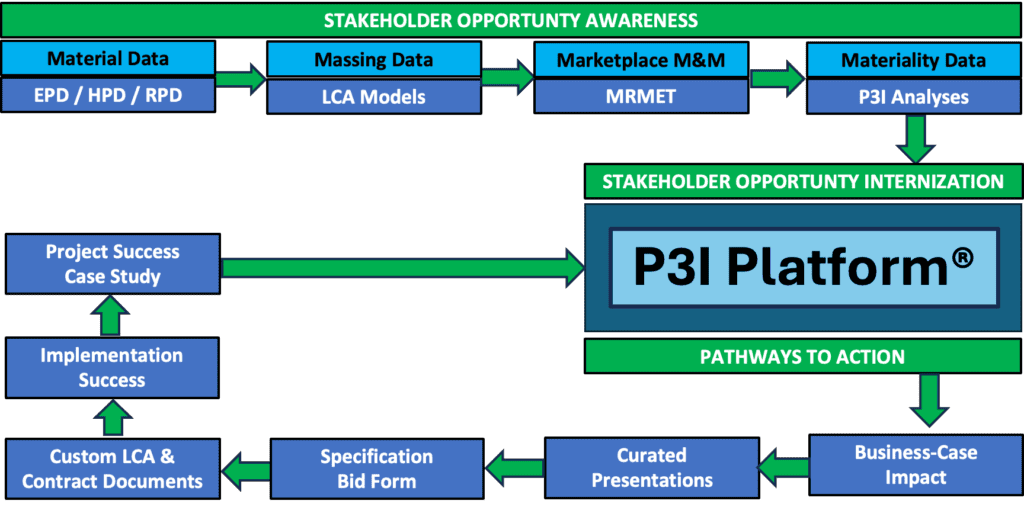
Enter the P3I.GLOBAL – P3I Platform®. The P3I.GLOBAL – Planet People Profit Impact (P3I) Platform® was initially designed to show our clients the environmental, social, and financial asset-dollar-value impact potential that generationally responsible best-practice designs, technologies, policies, and investment strategies could create for their projects. The P3I Platform® lets clients see asset-value impact in simple-to-understand dollar values without becoming building science professionals, master economists, green rating system scholars, lifecycle assessment modelers, or triple bottom line cost-benefit analysis experts.
The P3I Platform® has grown well beyond our initial purpose. In partnership with USGBC Texas P3I.GLOBAL is making the P3I Platform® available for building product manufacturers interested in knowing how their solutions are being evaluated under current marketplace conditions, and how voluntary green rating systems and known emerging lenses are going to impact a manufacturer’s ability to adapt and thrive.
The graphic below is an overview of how P3I.GLOBAL and USGBC Texas are onboarding manufacturers into an ever-changing marketplace. Details can be found at https://usgbctexas.org/iac
Contact David MacLean at david@p3i.global or +1 713.857.6499 if you want to understand how the marketplace is evaluating your solutions’ impacts and how we can turn obstacles into marketplace differentiation opportunities.